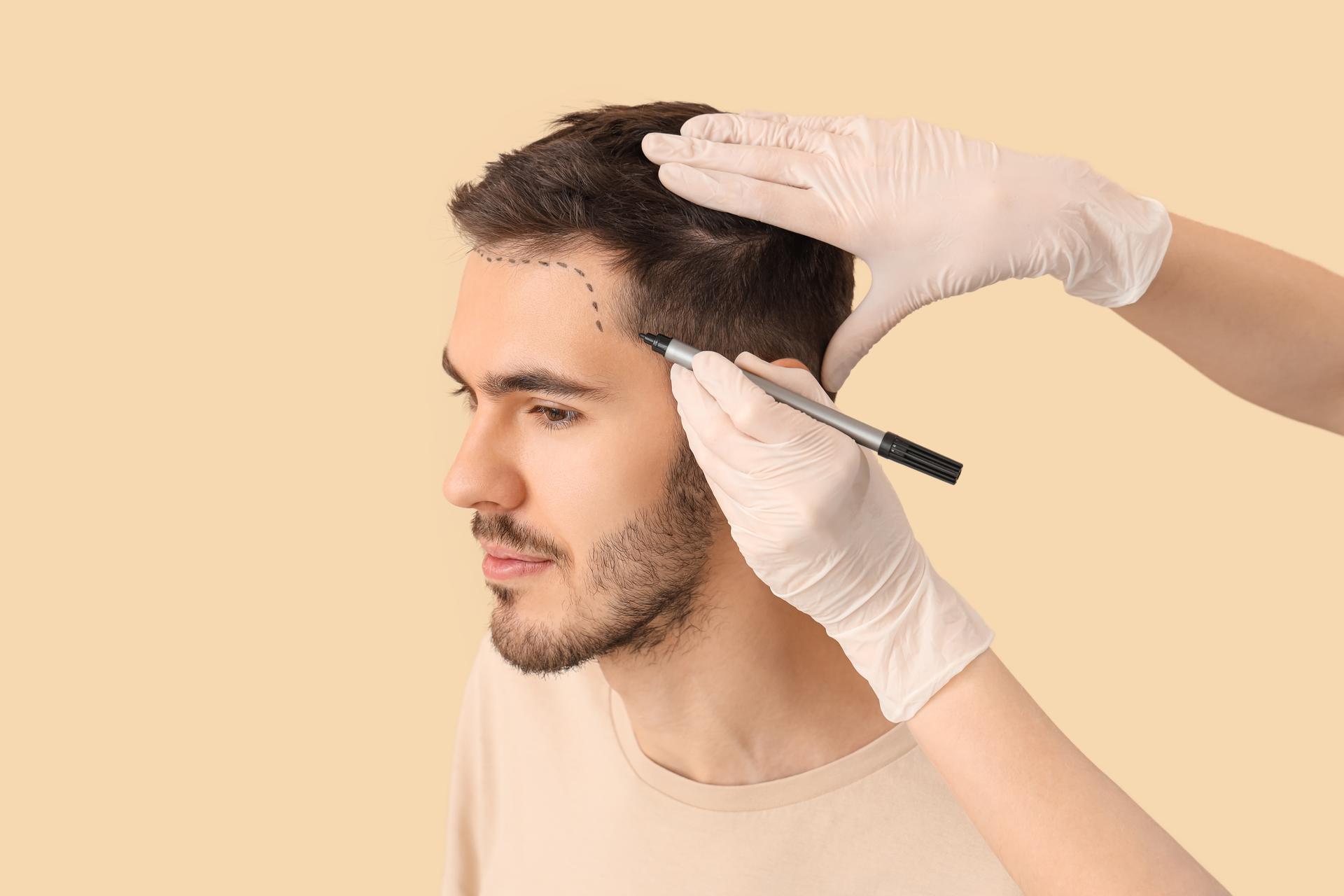
You know the difference between FUE and FUT, you’ve weighed the pros and cons, and you’ve probably spent more time than you’d care to admit scrolling through before-and-after galleries. You’re still not sure which approach is right for you, and you’re starting to wonder: what if you could use both techniques in a single procedure?
For certain patients, it’s the smartest path to comprehensive coverage. A combination FUE and FUT hair transplant uses both surgical techniques in the same session to maximize the number of grafts harvested, making it a practical option for patients with advanced hair loss who need extensive restoration.
At New Jersey Hair Restoration Center in Freehold, NJ, Dr. Emil Shakov is trained in both FUE and FUT through the prestigious Hair Transplant 360 program, a key distinction when you’re considering a procedure that demands fluency in both methods.
The Donor Dilemma: Why Your Hair Supply Is So Critical
Your donor area is not unlimited. The back and sides of your scalp, which are the regions where hair is genetically resistant to balding, contain a finite number of transplantable follicles. Once they’re gone, they’re gone.
If you’re dealing with significant hair loss, that finite supply becomes the single most important factor in your restoration strategy.
According to the International Society of Hair Restoration Surgeons (ISHRS), only about 2-3% of hair transplant patients receive combination FUT and FUE procedures. That number sounds small, but it likely underrepresents how many patients could actually benefit — particularly those with Norwood 5 or higher hair loss who need maximum coverage in fewer sessions.
What Is a Combination FUE and FUT Hair Transplant?
A combination hair transplant involves performing both follicular unit transplantation (FUT) and follicular unit excision (FUE) during the same surgical session. The goal is to extract the highest possible number of quality grafts while preserving the donor area for any future needs.
Dr. Shakov begins with FUT, removing a narrow strip from the back of the scalp where hair density is typically greatest. This strip is then divided under microscopic guidance into individual follicular units. Once the strip harvest is complete, he transitions to FUE, extracting additional individual follicles from the surrounding donor areas using a specialized micropunch tool.
By combining the two approaches, patients with extensive baldness can receive anywhere from 4,000 to 6,000 grafts in a single session. That’s roughly double what either technique alone might yield for the same patient.
Who Benefits From Combining FUE and FUT?
You might be a candidate for this approach if you have advanced hair loss, typically Norwood stage 5 or higher, where the balding area is simply too large to cover adequately with one technique. Some patients also prefer this route because they want comprehensive restoration in one session rather than returning for multiple procedures over several years.
Not everyone with significant hair loss qualifies. Your donor density, scalp characteristics, and overall health all factor into the equation. This decision requires an in-person consultation where Dr. Shakov can assess your specific needs.
The Sequence: FUT First, Then FUE — Here’s Why
The standard approach is FUT first, followed by FUE, and there’s good reasoning behind this sequence.
FUT allows Dr. Shakov to harvest from the most permanent, densest portion of the donor zone in one efficient strip. This area (roughly the middle third of the back of your scalp) tends to produce the highest-quality grafts with the greatest longevity. Microscopic dissection of the strip ensures minimal damage to individual follicles.
Once the strip is removed and the incision is sutured closed, Dr. Shakov transitions to FUE. This technique extracts supplementary grafts from the areas above and below the strip site, as well as potentially from the sides of the scalp. These follicles are slightly less permanent than the core safe zone, but they’re still viable candidates for transplantation, especially when you need maximum coverage.
Can Combination Transplants Be Enhanced With Other Treatments?
One advantage of working with a practice like New Jersey Hair Restoration Center is access to regenerative treatments that can support your results. Dr. Shakov often recommends combining surgical hair restoration with therapies like PRP, PepFactor, or exosome treatment.
These supplements can improve scalp health, support graft survival, and encourage existing follicles to perform better. Adding one of these treatments to your combination procedure isn’t required, but it’s worth discussing during your consultation. For patients investing in a combination surgical restoration to achieve maximum results, the additional benefit can be meaningful.
Why Surgeon Expertise Matters More in Combination Procedures
Plenty of surgeons perform FUE. Plenty perform FUT. Fewer are skilled in both, and even fewer have the judgment to know when combining them makes sense versus when it’s overkill.
Dr. Emil Shakov completed his hair restoration training through the Hair Transplant 360 Workshop, which specifically covers both FUE and FUT methodologies including hairline design, graft harvesting, dissection, and placement. He’s also a board-certified surgeon (FACS) with advanced fellowship training in aesthetic medicine, bringing together an indispensable level of expertise and artistry .
Find Out If a Combo FUE + FUT Procedure Is Right for You
You’re probably wondering whether a combination approach makes sense for your situation. The honest answer is: it depends. Your donor density, the extent of your hair loss, your goals, and your scalp characteristics all play a role. No article can tell you what’s right for you.
What we can tell you is that the consultation is where real answers happen. Dr. Shakov will examine your scalp and recommend a strategy, whether that’s FUE alone, FUT alone, a combination of both, or starting with non-surgical options first.
Schedule your consultation at New Jersey Hair Restoration Center in Freehold, NJ, or call 732-365-4533. The sooner you understand your options, the sooner you can make a decision you feel confident about.